

Rick Veitch got the phone call just as he was settling down for bed that night. It was 1989, and Veitch had been at work on the capstone storyline of his ambitious run on DC Comics’ Swamp Thing. The story was a doozy, the sort of thing that might have stood up against the most memorable issues of Alan Moore’s landmark run on the title. Over the course of the previous year, Veitch’s shambling, muck-monster antihero had traveled backward through time, encountering historical figures great and small. Now, in the climactic finale to close out Veitch’s tenure, Swamp Thing was about to play a role in the crucifixion of Jesus Christ Himself.
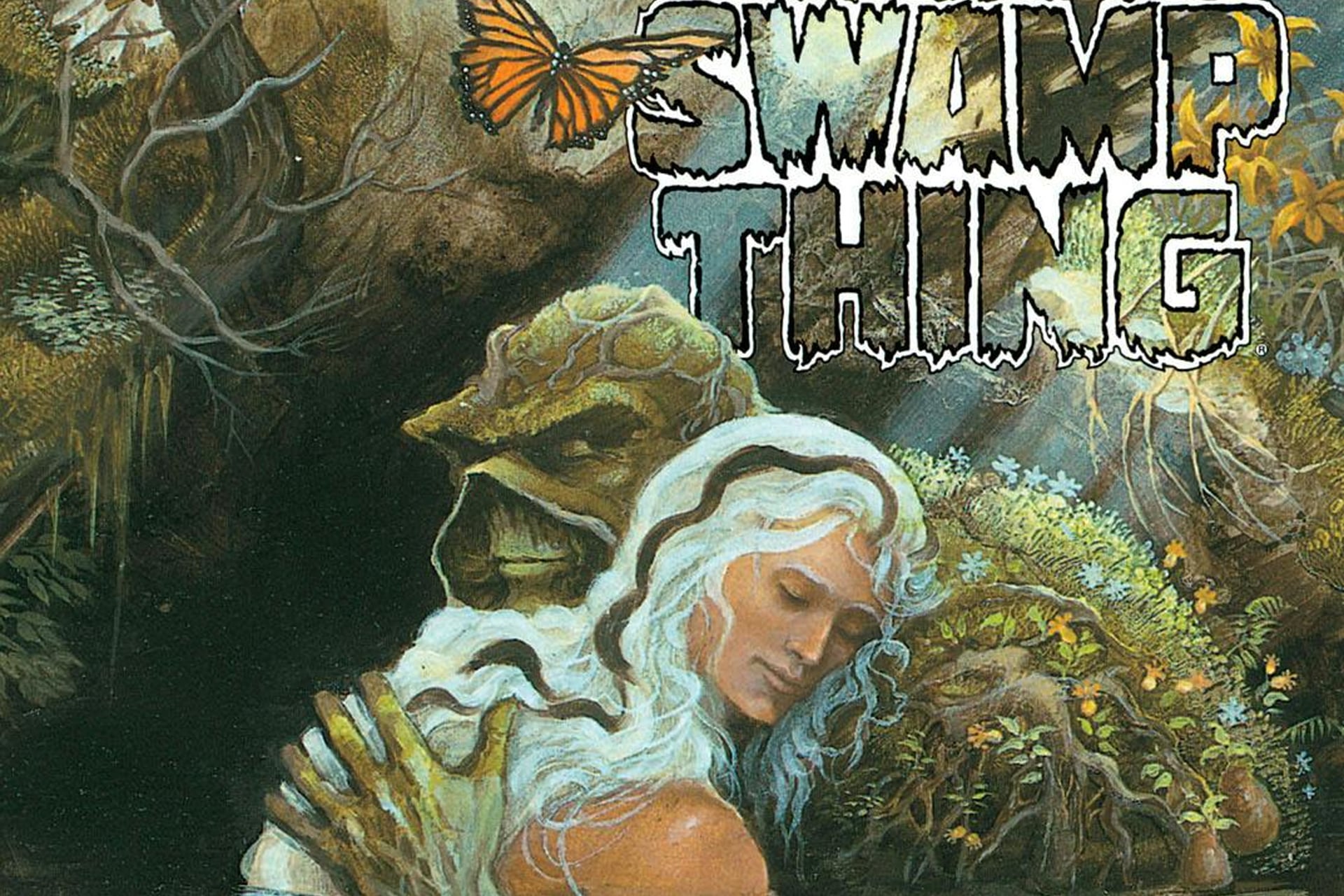
Astonishingly, the story had made it through editorial review: a plot had been written, the pencil art (by artist Michael Zulli) for the first issue of the story had been drawn, and the cover of Swamp Thing #88, a stunning scene of a pained Swamp Thing turned into a crucifix, had already been created. But now, at the last moment, the inevitable call came down from on high: the issue would be pulled, the story would be axed, and no more would be said about the encounter between Swamp Thing and the Son of Man.
For the next three decades, Veitch’s final Swamp Thing issues became the stuff of legend: often mentioned in rumors and industry gossip, argued about in the pages of fanzines and message boards, and, on at least one occasion, coming close to belated publication before getting yanked back into oblivion once again.
Until now. This month, DC is releasing Swamp Thing 1989, the first issue of a four-issue miniseries that will at last see the completion of the most infamous (and, depending on your point of view, blasphemous) DC storyline ever nearly made. On the occasion of this near-Easter miracle, io9 spoke with Veitch, artists Tom Mandrake, Vince Locke, and Trish Mulvihill, and others involved with the making (and unmaking) of the book to reflect on Swamp Thing’s long road to Calvary.
 One of the iconic issues of Moore’s run was Swamp Thing #34, “Rite of Spring” © John Totleben/DC Comics Taking Root
Rick Veitch was an unlikely pick to wind up at DC Comics. A veteran of the 1970s underground scene, his notable works before landing at the publisher included such non-Comics Code-approved titles as 1971’s horror-comedy Two Fisted Zombies and a Heavy Metal adaptation of the Steven Spielberg flop 1941, transformed into a dadaist acid trip (Spielberg wrote an admiring introduction to the paperback).
But in 1984, Veitch’s art school buddies Stephen Bissette and John Tottleben told him about a new writer named Alan Moore who had just taken over the Swamp Thing book they were already drawing. For Veitch, it was an almost religious epiphany.
At Bissette and Tottleben’s request, Veitch began ghosting parts of Swamp Thing from their earliest issues. “I got to work on those early Alan Moore scripts right from the beginning,” Veitch says. “I think in [seminal early Moore story] ‘The Anatomy Lesson,’ that whole opening sequence where they’ve got Swamp Thing in a tank, I drew all the machinery. So I got drawn back into DC at that point, started drawing some fill-in issues, and then became penciler when Steve and John left.”
The result of their collaboration was a memorably offbeat science fiction epic, in which the plant-based hero travels across the galaxy, encountering icons like Adam Strange of Rann and the hawk people of Thanagar. But if a Swamp Thing space opera took readers off guard, it could hardly prepare them for what came next: after four years of taking Swamp Thing to the top of the critical lists, Moore was calling it quits—and he wanted Veitch to take his place.
Bearing Mixed Fruit
To begin with, Veitch knew that Moore wasn’t going to be an easy act to follow. “He and I would make jokes about it: how I was committing career suicide,” Veitch remembers. “But I was the right person to do it because I was intimately involved with Swamp Thing since Tom Yates had been drawing it back in 1981. I was really invested in the characters of Abby, and Alec [Holland, Swamp Thing’s human quasi-alter ego]/Swamp Thing. I understood that it was a love story, and I could see these different paths of storytelling that I wanted to take, using DC characters.”
Veitch, who shared Moore’s love of the DC Universe, wanted to continue peppering his work with guest spots from the company’s all-stars like Batman and Superman. But, he says, “I think it was a problem for DC.”
The problem was this: the mid-’80s were a cultural high-water mark for Ronald Reagan, Jerry Falwell, and the Moral Majority. National media panics over the corrupting influence of role-playing games and rock and roll had become brief but hot scandals. For years, an internal debate had raged in comics over whether their small-time industry was especially at risk.
It was with this in mind that DC, in 1987, announced that it would be adopting an MPAA-style rating system for its books to mark off mature titles. The policy had been crafted without input from freelance writers and artists, and the resulting controversy led four of the company’s top creators—Alan Moore, Frank Miller, Howard Chaykin, and Marv Wolfman—to announce they would contribute no further work to the publisher while the policy remained in place. DC soon compromised with a less stringent labeling system for mature titles, and three of the four creators (with the exception of Moore) dropped their boycott. But for Veitch and Swamp Thing, the fallout still remained.
“I was already trying to explore ideas that I would use in [Veitch’s creator-owned title] Brat Pack,” Veitch says. “Amped up sex, amped up violence, and [exploring] the general kinkiness of superheroes. I mean, superheroes are kind of like kink for kids! So I was pushing the envelope in my scripts. I had Superman appear a couple of times, and both times I heard from DC, ‘Hey, you got to tone it down. You’ve got to focus on his heroism and his courage, not the fact that he’s a giant superpowered fascist.’”
According to Veitch, one early red flag emerged shortly after he took over as writer of Swamp Thing. “[DC] brought me down [to New York] and wined and dined me and took me to a Broadway play, and I got to meet with [DC President and Publisher] Jenette [Kahn]. This was right at the time when [DC] had tried to institute [their] standards and practices. They were trying to put the brakes on the violence and the sexuality that had been such a success with Dark Knight and Watchmen.”
A year into Veitch’s run on the title, it was clear that something would have to give.